Our Sahara desert tours
We publish five desert routes of 3 to 5 days, all private and all built around a camel ride and a camp night at Merzouga. They differ in where they start, where they end, how much driving each day holds and how long you spend at the dunes.
Desert tours
3-day Marrakech to Merzouga desert tour
The shortest way to reach the big dunes of Erg Chebbi from Marrakech, with Ait Ben Haddou, two gorges and a night in a desert camp.
From €500 per person
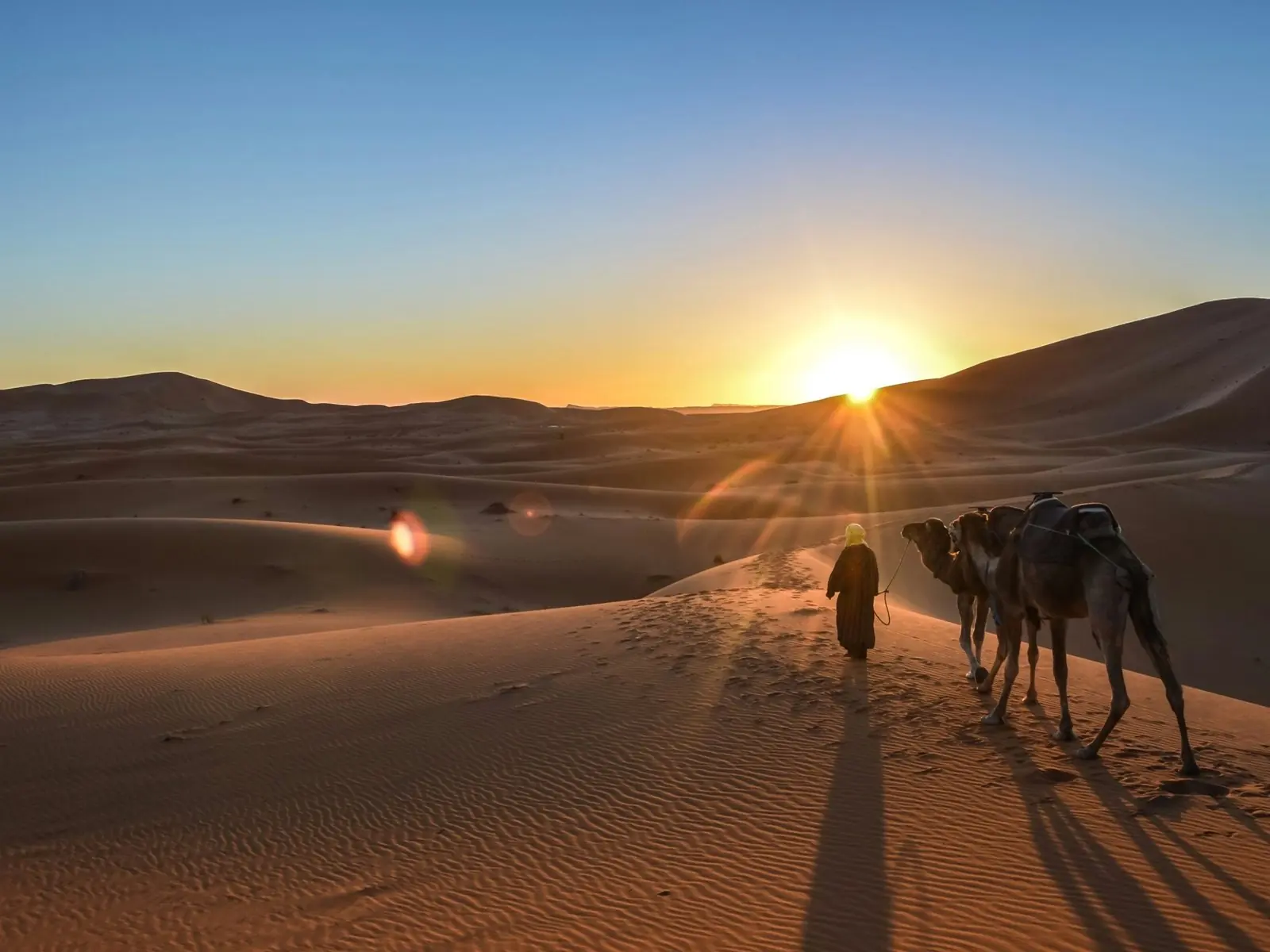
3-day Marrakech to Fes desert tour
A one-way crossing from Marrakech to Fes that swaps the motorway for the High Atlas, the Erg Chebbi dunes and the cedar forests of the Middle Atlas.
From €500 per person
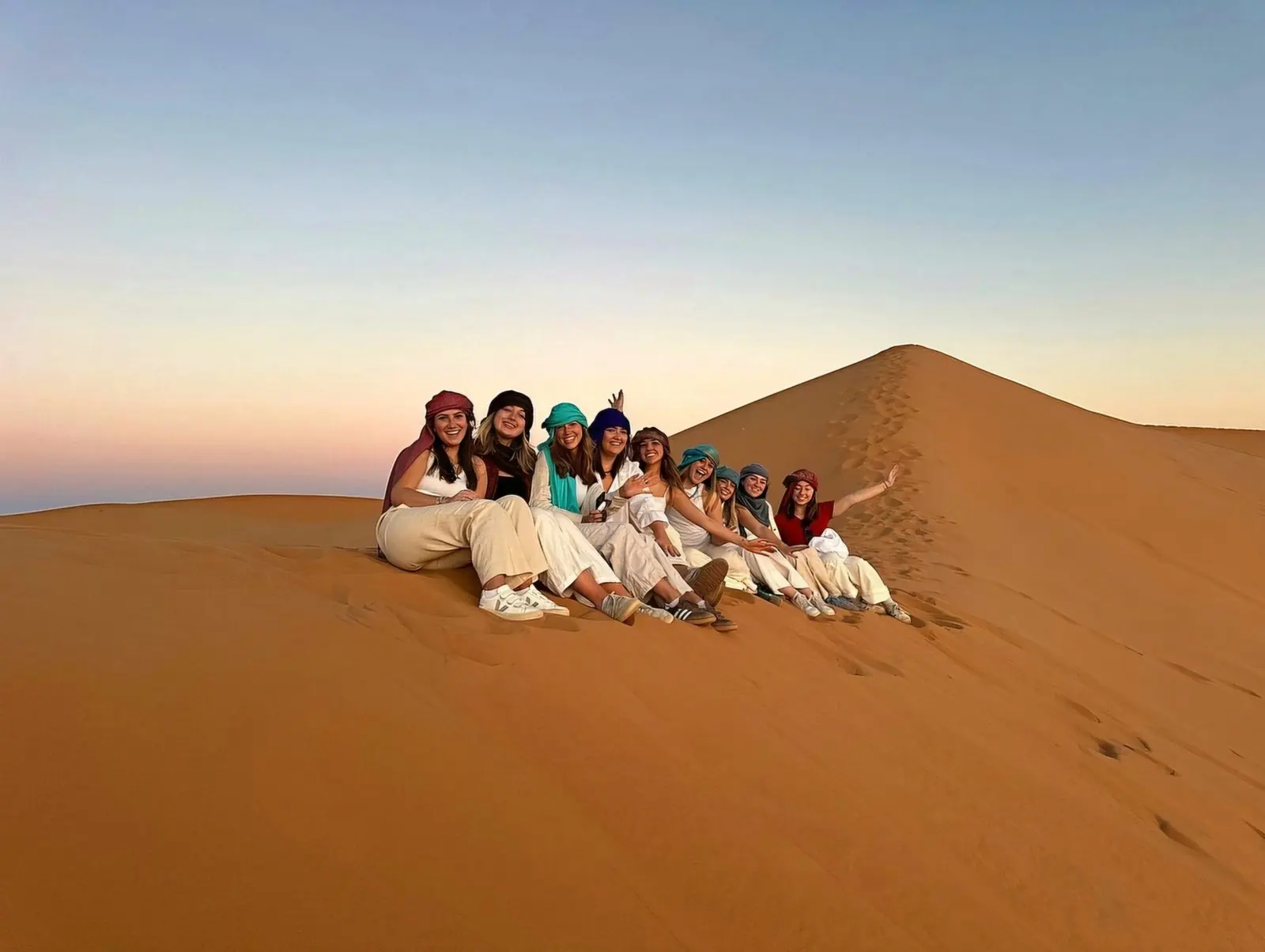
4-day Fes to Marrakech desert tour
Fes to Marrakech by the Sahara with a full day at Merzouga in the middle, so the dunes are more than an overnight stop.
From €600 per person
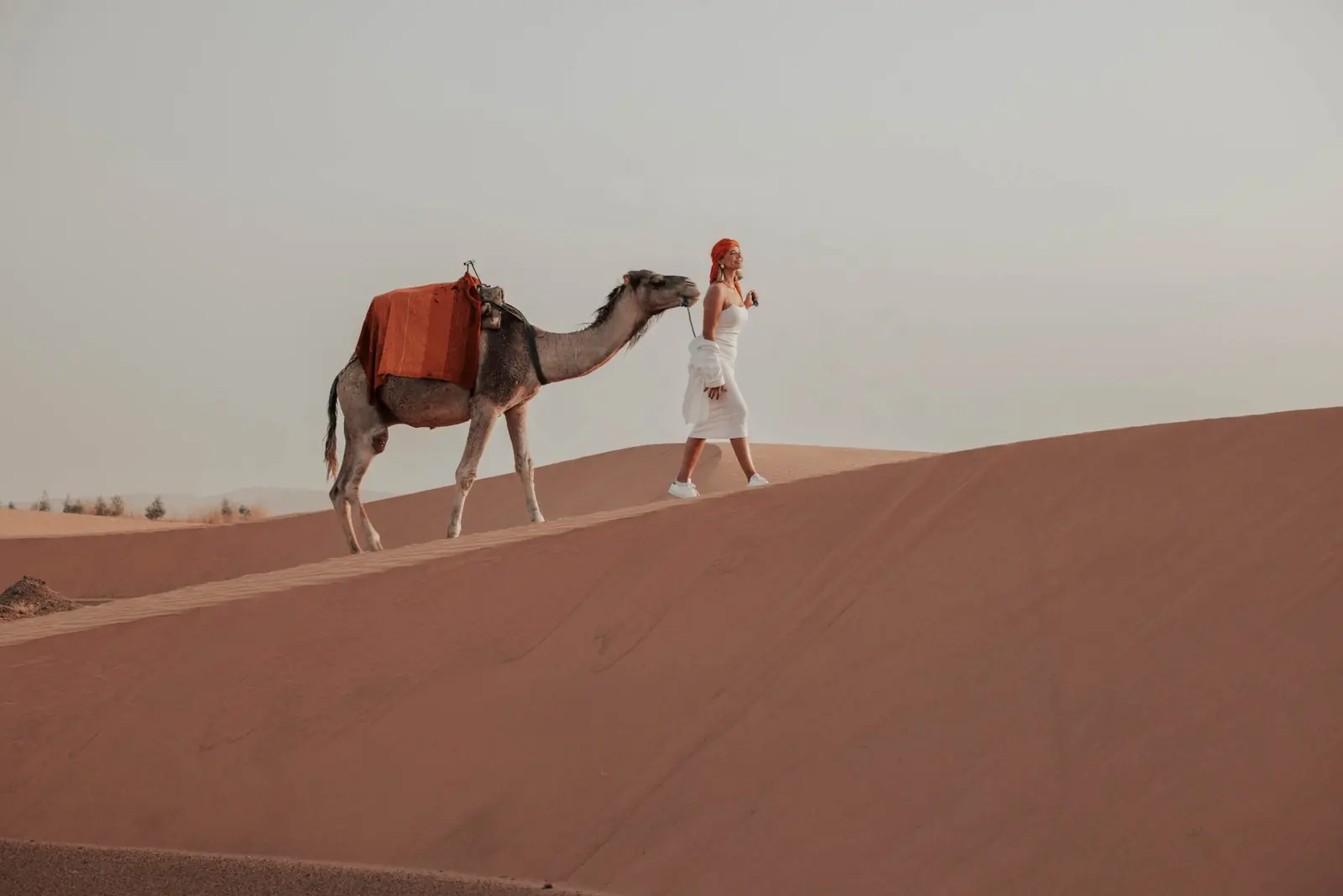
4-day Marrakech to Merzouga desert tour
The same dunes as the 3-day loop, with the long drive home cut in two by a night in Ouarzazate and a return through the Draa Valley.
From €600 per person
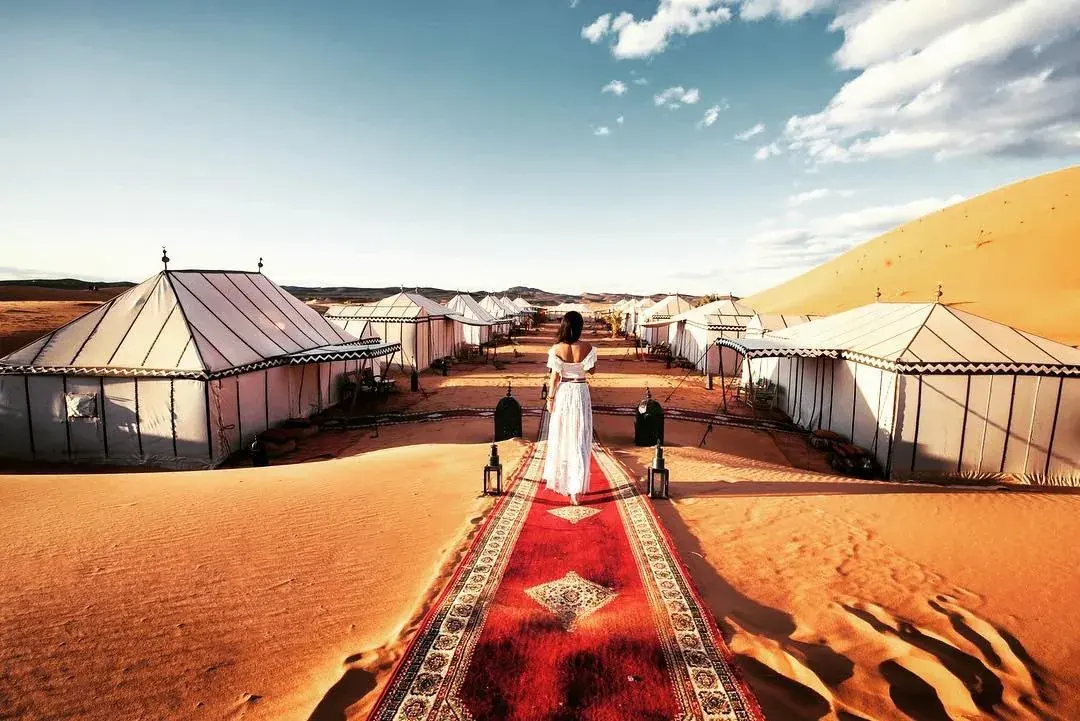
5-day Marrakech to Merzouga desert tour
The unhurried desert loop: a short first day, two nights at the Erg Chebbi dunes with a full day around Merzouga, and a different road in each direction.
From €700 per person
| Tour | Route | Longest driving day | Time at the dunes | Price per person |
|---|---|---|---|---|
| 3 days Marrakech to Merzouga | Round trip from Marrakech | 553 km on day 3 | One evening and one sunrise | €500 to €800 |
| 3 days Marrakech to Fes | One way, ends in Fes | 463 km on day 3 | One evening and one sunrise | €500 to €800 |
| 4 days Fes to Marrakech | One way, ends in Marrakech | 477 km on day 1 | A full day plus two evenings | €600 to €900 |
| 4 days Marrakech to Merzouga | Round trip from Marrakech, home by the Draa Valley | 362 km on day 3 | One evening and one sunrise | €600 to €900 |
| 5 days Marrakech to Merzouga | Round trip from Marrakech, a different road each way | 394 km on day 2 | Two nights and a full day | €700 to €1,000 |
Distances are the operator's road figures. The price range reflects group size and hotel and camp level. See Morocco tour cost.
Two points in the table are easy to miss. The two 4-day tours spend the extra day differently: the Fes route gives it to Merzouga, while the Marrakech loop uses it to split the long drive home with a night in Ouarzazate. And only the 5-day tour and the 4-day Fes route include a full day at the dunes in daylight.
How many days do you need for a desert tour?
Three days is the minimum and four is better. Merzouga is about 560 km from Marrakech and roughly 450 to 480 km from Fes, so no route reaches the dunes and returns in less.
- 3 days: two travel days and one night in camp. You see the High Atlas, Ait Ben Haddou and the gorges, but mostly through stops of an hour or less.
- 4 days: room for either a day at Merzouga itself, with the village of Khamlia, nomad families and the dunes, or a return to Marrakech in two stages instead of one.
- 5 days: both. The 5-day tour has a short first day to Ouarzazate, two nights at Erg Chebbi and a different road in each direction.
- 6 days or more: the desert becomes one part of a wider trip. The 6-day and 7-day tours from Marrakech add city nights and a guided walk in Marrakech.
What do you see on the road to the desert?
From Marrakech the road crosses the High Atlas and follows a line of kasbahs, palm groves and gorges for two days before the sand begins. Most of what people remember from a desert tour, apart from the dunes, is on this road.
| Stop | What it is | What to expect |
|---|---|---|
| Tizi n'Tichka pass | The road over the High Atlas, at about 2,260 m | A slow climb with many bends and several viewpoints. It can be cold and windy at the top even when Marrakech is hot. |
| Ait Ben Haddou | A fortified mud-brick village, a UNESCO World Heritage Site since 1987 | A walk of about an hour up lanes of craft stalls to the top of the hill. There is little shade. |
| Ouarzazate | The main town south of the Atlas, known for its film studios | Usually a short stop or a lunch break. The 4-day and 5-day Marrakech loops spend a night here. |
| Dades Valley | A long valley of kasbahs, fig and almond terraces and red rock | The usual place to sleep on the first night from Marrakech. Hotels are small and simple. |
| Todra Gorge | A narrow canyon with limestone walls about 300 m high | A flat walk of a few minutes along a shallow river. Busy in the middle of the day. |
From Fes the road is different: Ifrane, the cedar forest near Azrou, Midelt and the palm groves of the Ziz Valley.
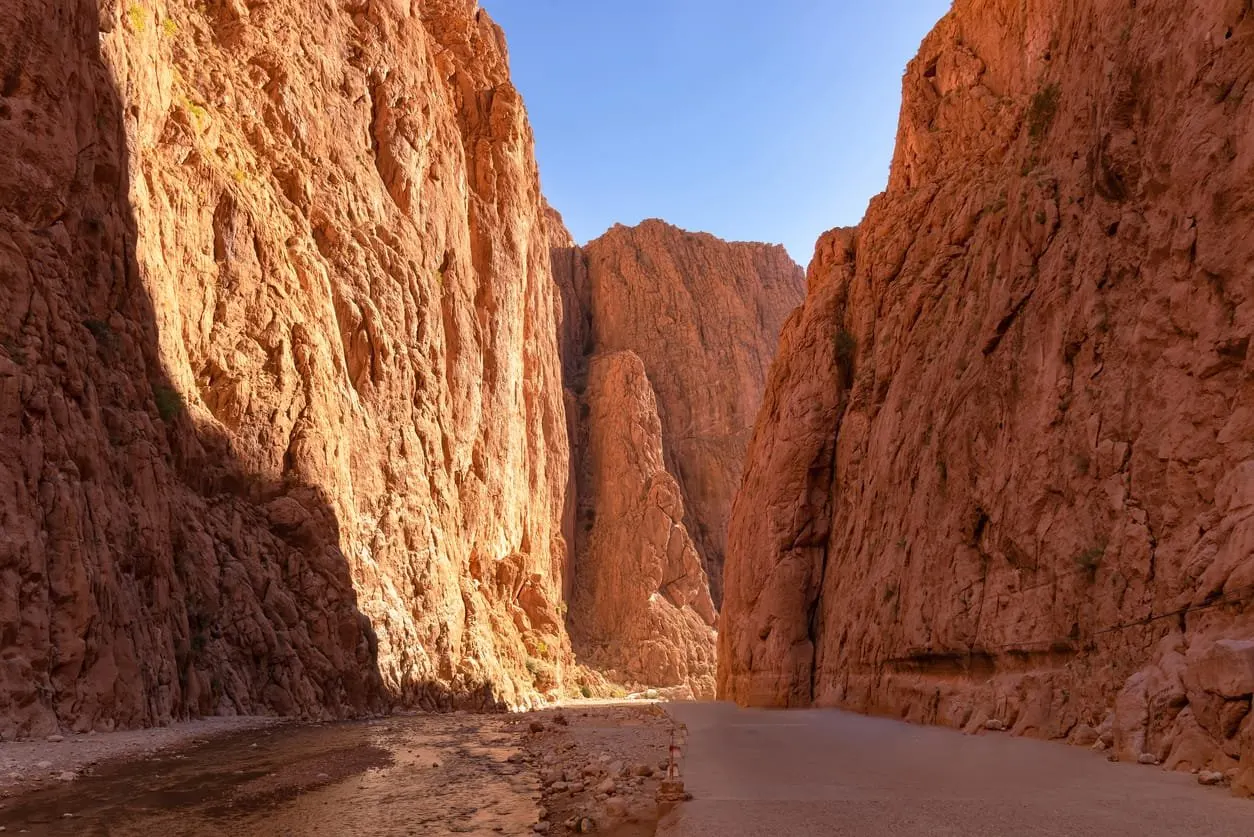
Lunch and entrance fees at these stops are not included, so carry dirhams in small notes. If one stop matters more to you than another, tell your driver in the morning. On a private tour the time can be moved from one to the other.
Merzouga, Zagora or Agafay: which desert?
Merzouga is the one with the high sand dunes most people have in mind. Zagora is closer with much smaller dunes, and Agafay is a stony plateau near Marrakech that is not part of the Sahara.
| Place | What it is | Time needed from Marrakech | Honest verdict |
|---|---|---|---|
| Merzouga (Erg Chebbi) | A field of sand dunes, the tallest about 150 m, reached by paved road | 3 days minimum | The dunes are worth the distance. The cost is two or three long days in a car. |
| Zagora | A town in the Draa Valley with low dunes nearby | Usually 2 days | A shorter drive through a fine palm valley, but the dunes are small. Do not expect the Merzouga landscape. |
| Agafay | A rocky desert plateau about 40 km from the city | Half a day or an evening | Good for a sunset dinner and a camel or quad ride. It is stone, not sand. |
All our published desert tours go to Merzouga. Agafay is one of our day trips from Marrakech. For Zagora, ask us.
There is a fourth option, Erg Chigaga, a remote dune field in the far south that needs a 4x4 transfer. We compare it in Erg Chebbi vs Erg Chigaga.
What happens on the desert day, hour by hour?
The desert day is a morning on the road, an afternoon arrival at Merzouga, a camel ride at sunset and a night in camp. The times below are typical for a tour arriving from the Dades Valley and shift with the season, because everything is set around sunset and sunrise.
- Morning: leave the Dades Valley after breakfast and stop at Todra Gorge. The drive to Merzouga is about 255 to 270 km, roughly five hours plus stops.
- Early afternoon: lunch on the road, then the last stretch as the land flattens and the first dunes appear.
- Mid to late afternoon: arrive at Merzouga. Main bags stay with the vehicle. You pack a small overnight bag and have time for tea.
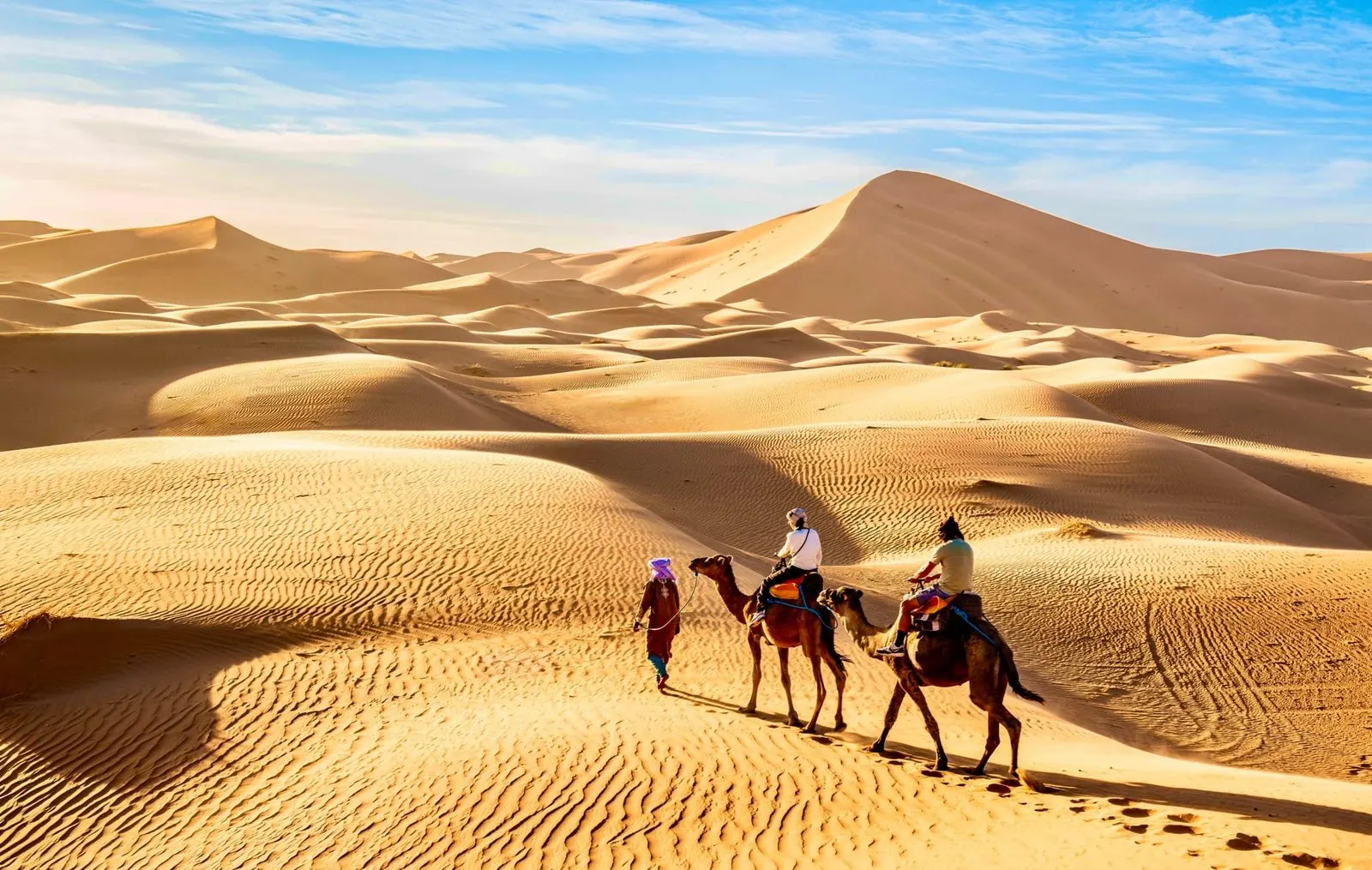
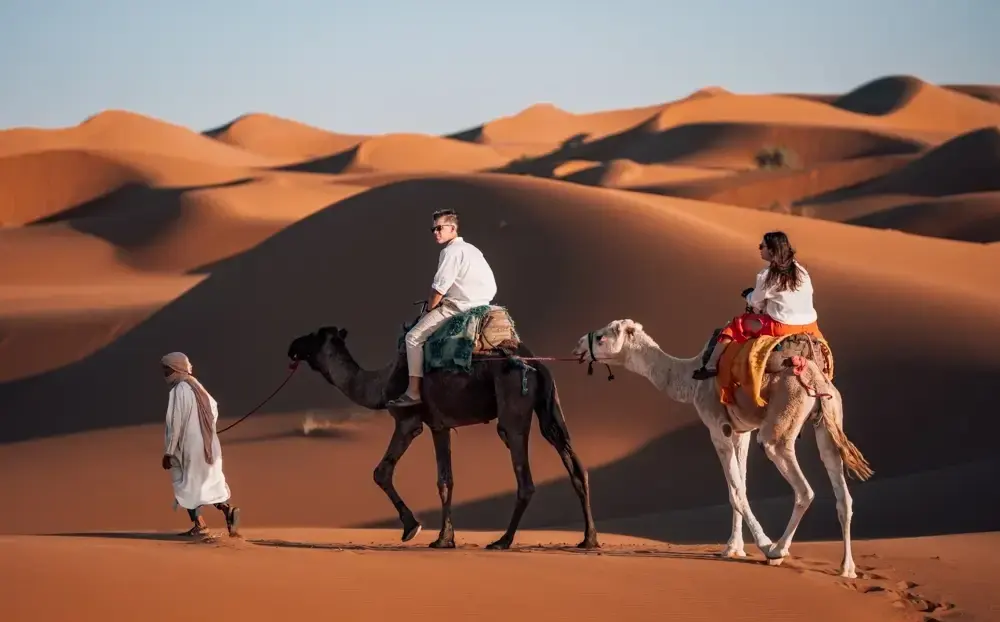
- About an hour before sunset: the camel ride into Erg Chebbi, with a stop on a dune to watch the light go.
- Dusk: reach camp, find your tent and wash.
- Evening: a Moroccan dinner, then often drumming around a fire.
- Night: very little artificial light, so the stars are clear on a cloudless night.
- Before dawn: a wake-up call and a short climb up a dune for sunrise.
- Morning: breakfast, the ride or drive back to the vehicle, and the road again.
On tours with a second night at Merzouga, the next day is slow by design: the village of Khamlia, a visit to a nomad family, a short drive around the edge of the dunes and free hours in the afternoon. On the 4-day Fes to Marrakech tour the order is reversed. You sleep in a hotel beside the dunes on arrival and ride to camp the following evening, when the eight-hour drive is behind you.
How long is the camel ride, and do you have to do it?
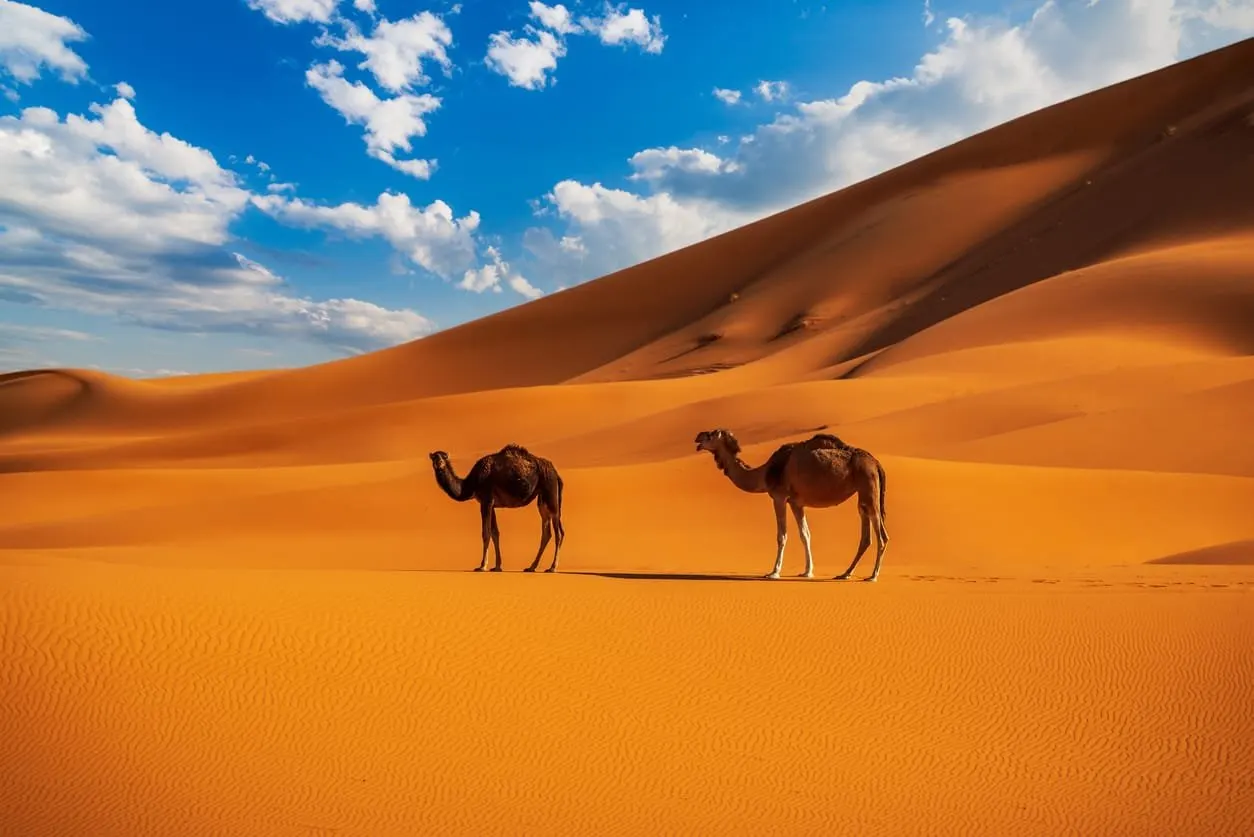
The ride to camp usually takes around an hour, depending on where the camp sits in the dunes, and it is not compulsory. A camel ride is included on every desert tour, and most camps can also be reached by 4x4 if you would rather not ride.
- How it works. You ride in a line led by a camel handler on foot. The camels walk slowly and you hold a metal handle on the saddle.
- The awkward part. Getting up and down. The camel rises back legs first, so lean back and hold on.
- Comfort. An hour is enough for most people. Long trousers are more comfortable than shorts.
- Who should think twice. Anyone with a back or hip problem, anyone pregnant, and very young children. Ask us for the 4x4 instead.
- Cameras and phones. Use a strap. Sand finds its way into everything, so keep lenses covered when the wind is up.
What are the desert camp levels?
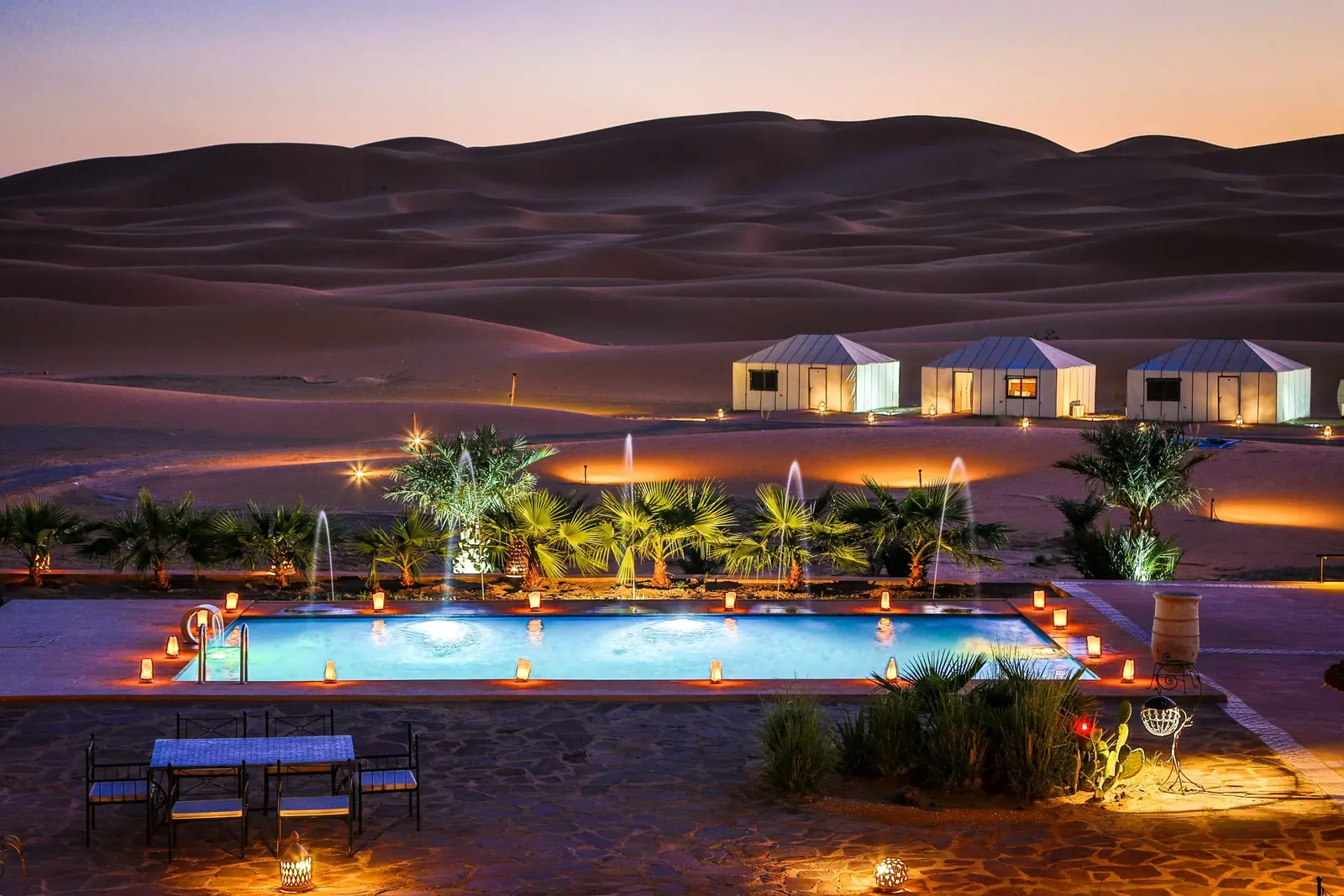
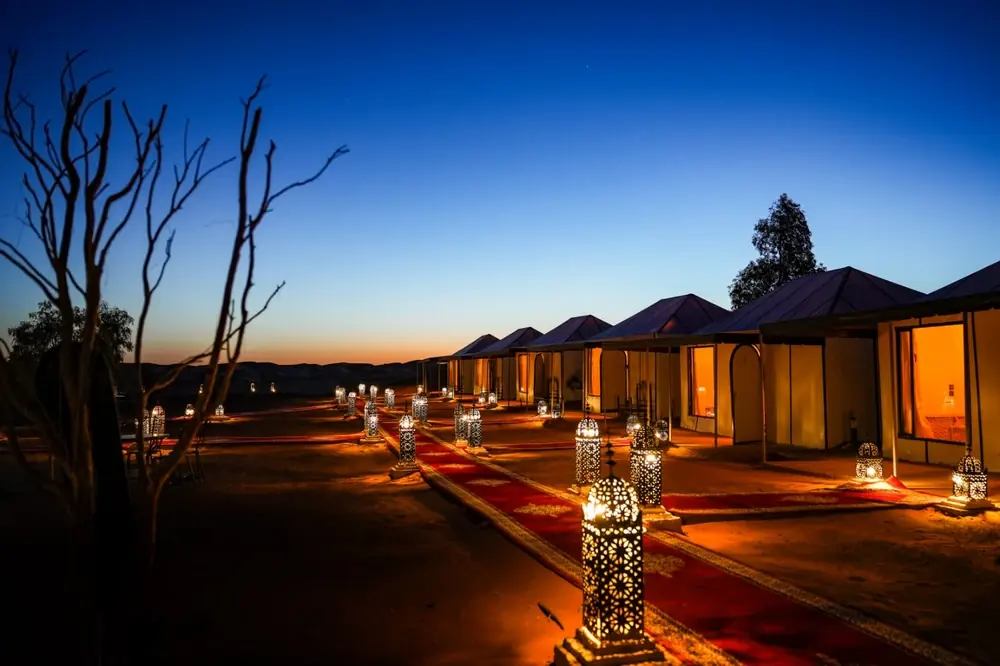
Camps come at standard, comfort and luxury level, and the main difference is the tent and the bathroom. The dunes, the sunset and the sky are the same at every level.
| Level | Tent | Bathroom | Worth knowing |
|---|---|---|---|
| Standard | A simple tent with beds and blankets | May be shared | The lowest price. Fine for one night if you are not fussy. |
| Comfort | A step up in space and furnishing | Ask when you enquire | The middle choice. Confirm what the tent includes for your dates. |
| Luxury | A larger tent with proper beds | Private, inside the tent | The upgrade most travellers notice, above all families and couples. |
The camp for your dates is named in your quote. Our guide to a luxury desert camp in Merzouga lists the questions to ask about heating, hot water and bed layout.
What else can you do at the dunes?
Beyond the camel ride, the usual activities are sandboarding, quad bikes, buggies and 4x4 outings. Apart from the camel ride these are optional extras paid separately, with one exception: sandboarding near camp is included on the 5-day tour.
- Sandboarding. Informal sliding down a dune near camp on a board. Climbing back up is the hard part.
- Quad bikes and buggies. Run on tracks at the edge of the dunes. Noisy and dusty, and not to everyone's taste, but popular.
- 4x4 outing. A drive around the dune field to Khamlia, nomad tents and viewpoints. Part of the Merzouga day on longer tours.
- Walking. Free, and the quietest way to see the dunes. Go early or late and keep the camp in sight.
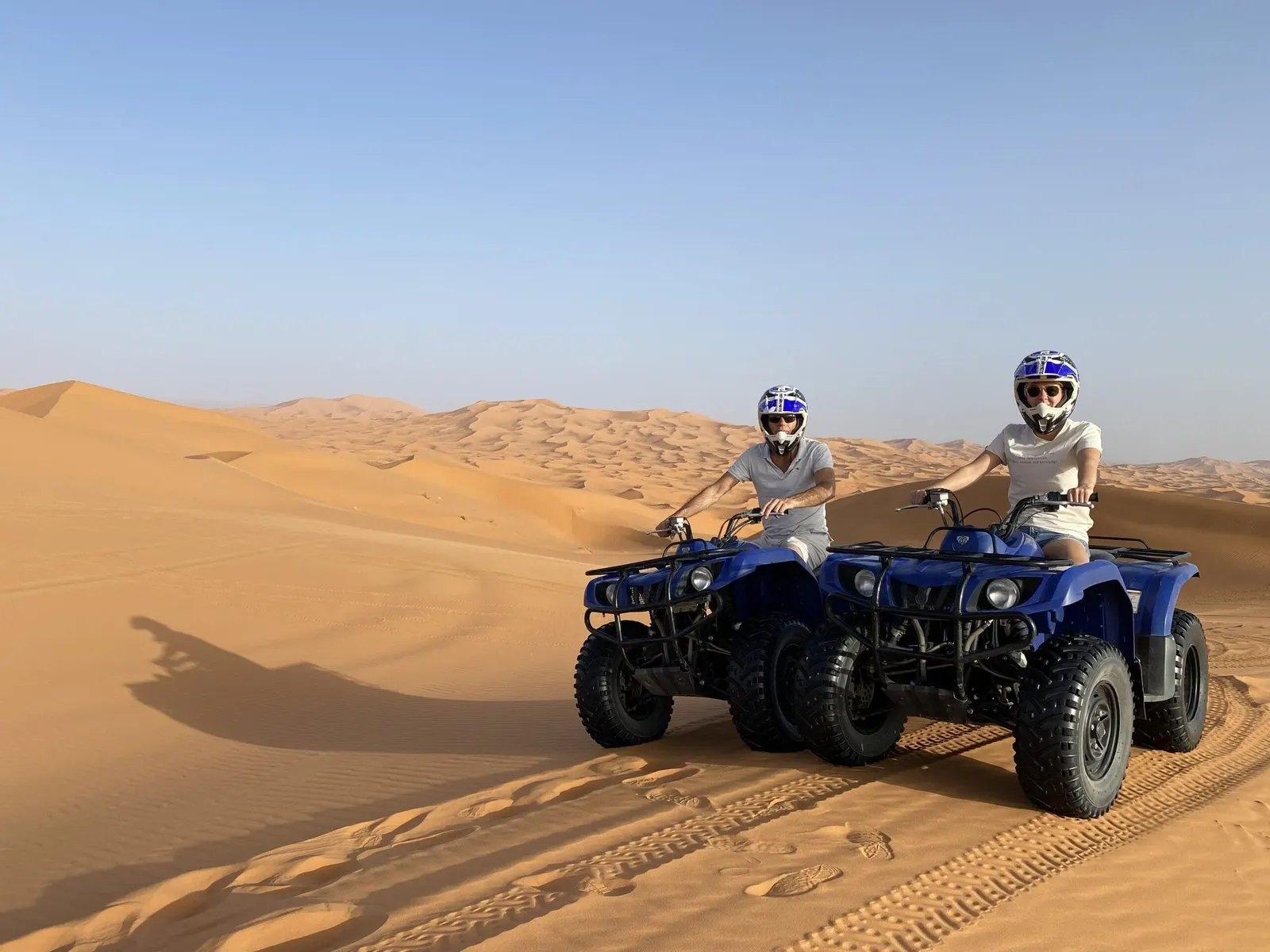
These activities need daylight at Merzouga, so they fit best on tours with a full day there. On a 3-day tour you arrive in the afternoon and leave after breakfast, which leaves room for very little besides the ride and the sunrise.
When is the best season for the desert?
Spring and autumn are the most comfortable, roughly March to May and late September to November. Prices are the same all year, so the choice is about heat, cold and crowds.
| Season | Days | Nights | What changes |
|---|---|---|---|
| Spring | Warm | Cool | The busiest time with autumn. Wind can lift sand on some days. |
| Summer | Often 40°C or more | Warm | The camel ride moves to the coolest hours and the middle of the day is spent indoors. |
| Autumn | Warm, cooling from November | Cool | Busy. Camps at each level fill early. |
| Winter | Mild and often sunny | Can drop close to freezing | Bring warm layers. Snow can slow the Tizi n'Tichka pass. |
Month-by-month detail is in the best time to visit Morocco.
What should you pack for a desert tour?
Pack for sun in the day and cold at night, and put what you need for the camp in a small bag you can carry on a camel.
- A small overnight bag or daypack. Your main luggage stays with the vehicle.
- A warm layer. A fleece or jacket for the evening and the sunrise, and a hat and gloves from November to February.
- A scarf. For sun, wind and sand. They are sold all along the road if you forget.
- Sun protection. Sunscreen, sunglasses and a hat.
- Closed shoes for the road stops, and sandals for the sand.
- A torch or headlamp and a power bank. Charging points in camp vary.
- Cash in dirhams for lunches, drinks, tips and extras.
- Any medication you need, including for motion sickness if mountain bends affect you.
Clothing advice for the rest of the country is in what to wear in Morocco.
Common mistakes on a desert tour
- Booking three days when you have four. The extra day is the difference between passing through the desert and spending time in it.
- Looping back when you could go one way. If your trip continues north, ending in Fes saves the 553 km return to Marrakech.
- Expecting dunes at Agafay or Zagora. Only Merzouga and the remote Erg Chigaga have the high sand.
- Packing for heat only. Desert nights are cold for much of the year.
- Carrying no cash. Lunch stops, tips and extras on the road are mostly paid in dirhams.
- Planning to see Fes or Marrakech on arrival day. You get in during the evening after a long drive. Keep a full day for the city.
- Not asking which camp. Ask for its name and whether the tent has a private bathroom before you agree.
Questions people ask
Can you visit the Sahara on a day trip from Marrakech?
No. Merzouga is about 560 km away, a drive of 9 to 10 hours each way. The Agafay Desert is the only desert landscape within day-trip range, and it is rock, not dunes.
Do you need a 4x4 to reach Merzouga?
No. A paved road runs all the way to Merzouga. A 4x4 is only needed for remote areas such as Erg Chigaga.
Is the camel ride included?
Yes. A camel ride in the Sahara is included on every desert tour. Quad bikes, buggies and extra 4x4 outings are optional and paid separately.
Which desert tour has the least driving per day?
The 5-day Marrakech to Merzouga tour starts with a short 195 km day and has a rest day at the dunes, though its second day is 394 km. The 4-day Marrakech loop keeps every day at 362 km or less.
Are dinners included on desert tours?
Yes. On the 3, 4 and 5 day desert tours, breakfast and dinner are included every day. Lunches and drinks are not.
Are desert tours suitable for children?
Yes, with a slower plan. A private tour can add rest stops, and four or five days is kinder to children than three because the driving days are shorter.
Is one night in the desert enough?
One night covers the camel ride, sunset, stars and sunrise. A second night at Merzouga gives a full day there without spending it in the car.